Drowning Prevention: Simple Steps That Can Save a Child’s Life
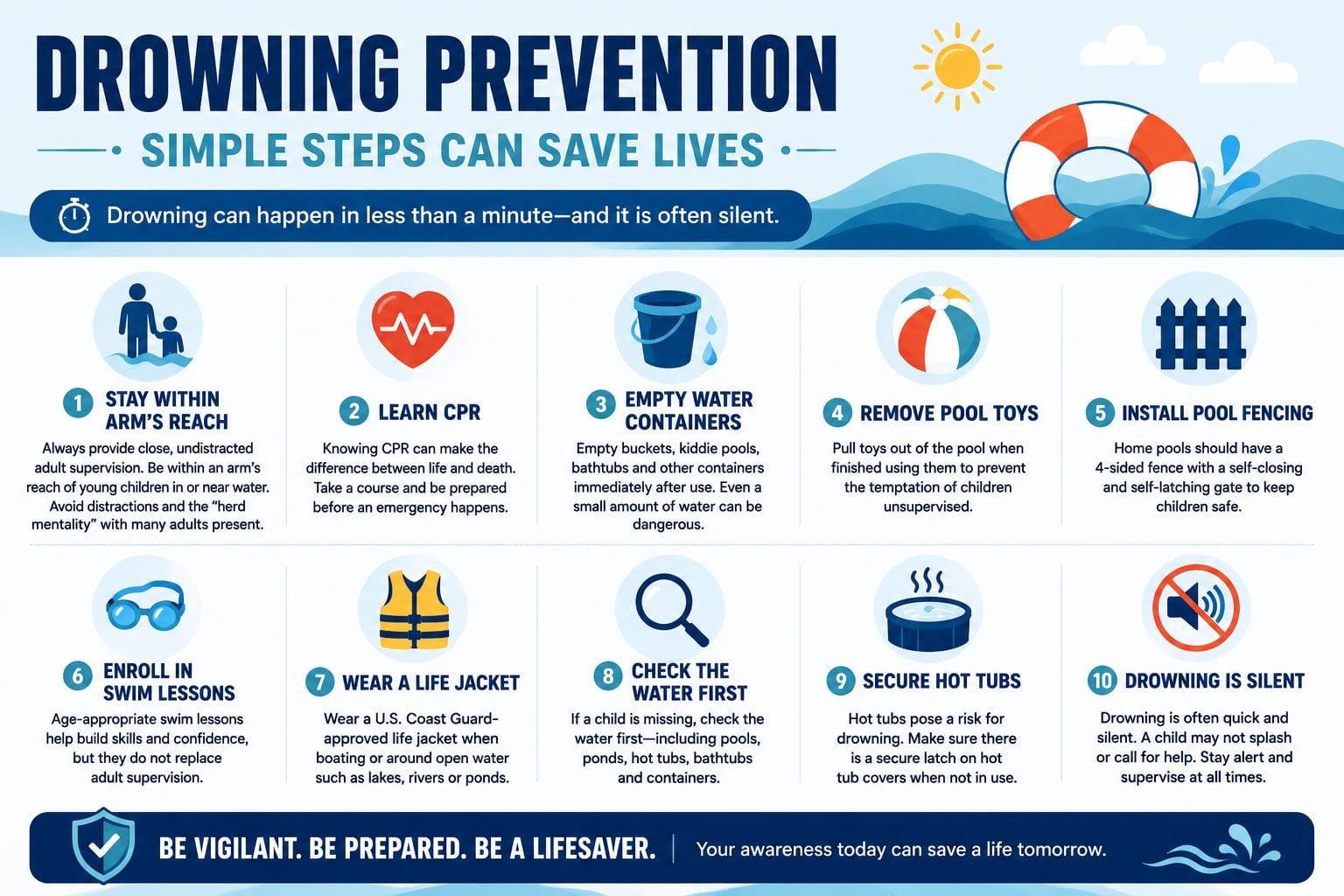
Swimming, boating and spending time around the water can create some of the best summer memories for families. Unfortunately, drowning can happen quickly—sometimes in less than a minute—and it is frequently silent.
Unlike the dramatic scenes often shown in movies, a child who is drowning may not be able to yell, wave or splash for help. Close supervision and a few important safety precautions can help prevent a tragedy.
Always Stay Within Arm’s Reach
Young children should always have close, undistracted adult supervision when they are in or around water. For infants, toddlers and inexperienced swimmers, the supervising adult should remain within arm’s reach.
It is especially important to avoid the false sense of security that can happen when several adults are present. Each adult may assume someone else is watching the children. Instead, designate one responsible adult as the active “water watcher.”
The water watcher should avoid distractions such as:
- Cellphones
- Reading
- Long conversations
- Preparing food
- Alcohol
- Leaving the pool area, even briefly
Learn CPR Before an Emergency Happens
Cardiopulmonary resuscitation, commonly called CPR, can help keep oxygen moving through the body until emergency medical professionals arrive.
Parents, grandparents, babysitters and other caregivers should consider completing an infant and child CPR course. Knowing what to do during the first few minutes of an emergency could save a child’s life.
Keep emergency numbers readily available and always call 911 immediately when a drowning or near-drowning incident occurs.
Empty Small Water Containers After Use
Swimming pools are not the only places where children can drown. Even a small amount of water can be dangerous to an infant or toddler.
Empty and properly store water containers immediately after use, including:
- Buckets
- Kiddie pools
- Bathtubs
- Coolers
- Large pet water containers
- Decorative fountains
- Other containers that can collect standing water
Toilets can also present a risk to very young children. Keep bathroom doors closed and consider using toilet lid locks when appropriate.
Remove Toys From the Pool
Pool toys can attract children back toward the water after swimming time is over. Remove balls, floats, goggles and other toys from the pool and surrounding area when they are not being used.
Children should never be allowed to retrieve a toy from the water without an adult present.
Use Four-Sided Pool Fencing
Home swimming pools should be surrounded by a four-sided fence that completely separates the pool from the house and yard.
The fence should include a self-closing and self-latching gate. The latch should be positioned high enough that a young child cannot easily reach or open it.
Pool alarms, gate alarms and secure pool covers can provide additional protection, but they should never replace proper fencing and adult supervision.
Enroll Children in Swim Lessons
Age-appropriate swim lessons can help children become more comfortable and capable in the water. Lessons may teach floating, basic swimming skills and how to reach the side of a pool.
However, swim lessons do not make a child “drown-proof.” Children who know how to swim still require close adult supervision whenever they are near water.
You can view local Garfield County swimming holes that offer swim lessons below.
- Rifle Metro Pool: View Website
- Glenwood Rec & Community Center: View Website
- Carbondale Rec Center: View Website
Use Proper Life Jackets
Children should wear a properly fitted, U.S. Coast Guard-approved life jacket when boating or spending time around lakes, rivers, ponds and other open water.
Inflatable pool toys, water wings and swimming rings are not substitutes for approved life jackets. These products may deflate, slip off or give adults and children a false sense of security.
A properly fitted life jacket should be appropriate for the child’s weight and should not ride up over the child’s face when lifted at the shoulders.
If a Child Is Missing, Check the Water First
If a child cannot be found, immediately check all nearby sources of water before searching elsewhere. Every second matters during a drowning emergency.
Check:
- Swimming pools
- Hot tubs
- Ponds
- Creeks
- Bathtubs
- Kiddie pools
- Buckets and other water containers
Call 911 immediately if a child is found unresponsive or struggling in the water.
Remember That Hot Tubs Pose a Risk
Hot tubs can be dangerous to young children because of their depth, heat and powerful suction systems.
Keep hot tubs covered with a securely latched safety cover whenever they are not being used. Children should never be allowed to enter or play near a hot tub without close adult supervision.
Drowning Is Frequently Silent
A drowning child may not be able to shout for help. Their head may be low in the water, their mouth may be near the surface, or they may appear to be climbing an invisible ladder.
Other warning signs may include:
- Gasping or struggling to breathe
- Hair covering the eyes or face
- Eyes that appear glassy, closed or unfocused
- Trying to roll onto the back
- Making little or no forward progress while swimming
- Being unusually quiet or motionless in the water
Never assume that a quiet child in the water is safe. Check immediately whenever something does not look right.
Create Layers of Protection
No single water safety measure is enough on its own. The safest approach uses several layers of protection, including:
- Close and undistracted adult supervision
- Four-sided pool fencing
- Self-closing and self-latching gates
- Age-appropriate swim lessons
- Properly fitted life jackets
- Secure hot tub and pool covers
- CPR training for parents and caregivers
- Removing toys and emptying water containers after use
Enjoy the Water Safely
Drowning can happen quickly and quietly, but many drowning incidents are preventable. Staying alert, preparing for emergencies and creating multiple layers of protection can help keep children safe around pools, ponds, lakes, bathtubs and other sources of water.
If you have questions about your child’s health, development or safety, contact the team at Castle Valley Children’s Clinic. We are here to help families build healthy and safe lives from the start.